
Research & Evidence
Therapeutic practice
We draw upon a range of evidence-based therapeutic practices in our Mountain Bike Therapy. The MIECAT form of inquiry underpins many of the processes. This is a multi-modal collaborative inquiry which is adapts a relational and experiential arts-based approach.
Our guiding framework draws upon Adventure Works Australia’s (AWA) Outdoor and Adventure Therapy Practice.
Both MIECAT and AWA utlise experiential learning as a way to support people to come to know themselves and the world.
“Characterised by the knowing that occurs through doing, being immersed in the present moment and multi-sensory experiencing in the here and now.
Prioritising lived and living subjective experiences as our primary sources for understanding ourselves and our relationships in and with the world.
The College of Creative & Experiential Therapies, PACFA
Mountain Biking as a form of therapy
“Mountain Bike Therapy” is part of the diverse range of Outdoor Adventure Therapy and Outdoor Health modalities. It utilises the inherent qualities of the mountain biking experience for therapeutic & wellbeing outcomes.
Research worldwide shows the evidence of the benefits of mountain biking as a form of therapy.
Mountain biking both attracts and benefits people, who would not otherwise participate in team sports or outdoor activities. It also offers an alternative therapeutic option for those who those who have been unable to engage with other processes.
Research conducted as part of a Mountain bike program with youth in Western Australia found that “non-traditional recreation activities resonate with individuals who are socially at-risk, and that participation in mountain biking and other outdoor recreation programs can facilitate the development of interpersonal and life skills, and improved risk assessment, problem solving and decision-making skills” (Wood et al, 2017).
Programs worldwide are using mountain biking, bike riding and maintenance as a form of therapy. There are programs focused specifically on mountain biking as the therapeutic modality and also those incorporating mountain biking as part of a broader adventure therapy suite. As the bicycle industry develops the diversity of riders is increasing (e.g. families and older adults) as well as there being more gender inclusion. Adaptive bicycles are providing opportunities for participants needing accessible equipment and trails to participate more. See below for more information on the benefits of mountain biking for therapy.
*Wood, N., Smith, J. W. N., & Wood, L. J. (2017, October). Breaking the cycle: Mountain biking as a way of engaging at-risk and disengaged youth. School of Population and Global Health, University of Western Australia.
DOI: 10.13140/RG.2.2.34098.09922
Mountain Biking for Mental Health & Wellbeing
Through intentionally reflecting upon mountain biking (e.g. the riding journey, acquisition of skills, time with nature, challenges and triumphs) riders can make meaning of the unique qualities the experience brings. Developing Mountain Biking in Scotland’s (DMBinS) “Trail Therapy” program fosters mental health and wellbeing through mountain biking in the group setting. Their aim is to “share the joys and obtainable challenges of mountain biking with individuals who have an existing mental health diagnosis. The program is designed to help riders grow in confidence, improve social interactions, establish skills of self-regulation, and accelerate their road to wellbeing” (Developing Mountain Biking in Scotland, 2025). This involves fostering skill development and enhancing fitness while also supporting the riders’ mental health challenges, through preparation and in real-time on the trail.
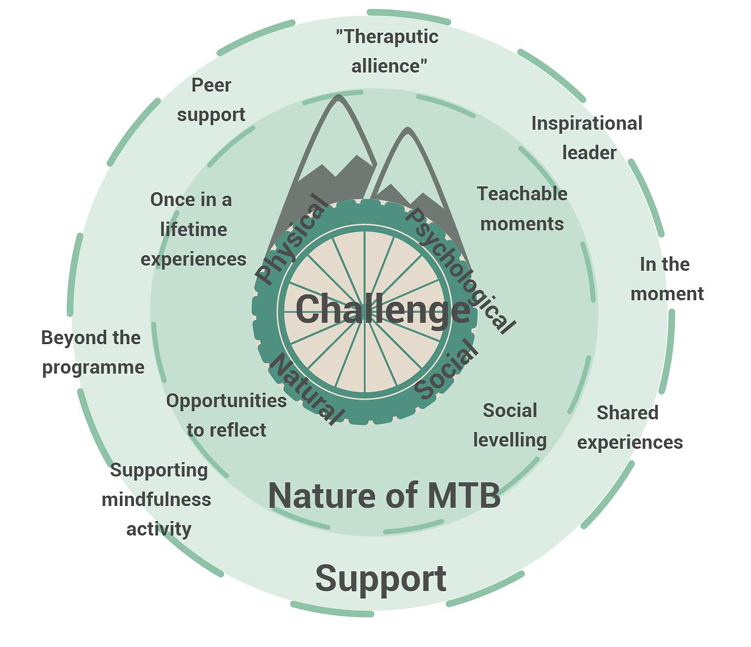
The Edinburgh Napier University has evaluated the impact of the DMBinS program. The research highlights the “unique combination of physical, psychological, social, and natural challenges that are inherent within an MTB therapy approach. These interrelated challenges shape the riders’ experiences on the program and sit at the centre of what makes it effective. It is clear from the data that the riders and facilitators emphasise the holistic impact on their overall wellbeing, and that due to the unique nature of MTB these would be difficult to replicate in other settings. The final ‘layer’ that contributes to the outcomes of the program appear to be support that riders receive from those facilitating as well as others taking part in the program” (Fountain et. Al, p.23).
Fountain, H., Ingram-Sils, L., & Westbury, T. (2023). Evaluating the impact of a trail therapy program, Edinburgh Napier University, Scotland.
Research
“Exploring connections to nature and sustainability through a process of experiential arts based inquiry.”
Erica Gurner, Natalya Garden-Thompson & Maureen Carey.
Eingana, v.36 n.1 p.18-21; April 2013, 36(1), 18–21.
“Life After Art School: An Inquiry into Fine & Visual Art Graduates’ Experiences of Creative Stuckness”
Natalya Garden-Thompson, The MIECAT Institute, Masters Dissertation, 2014
Benefits
Evidence worldwide documents the benefits of mountain biking and cycling – it shows how it improves physical, psychological, cultural, social, & ecological aspects of wellbeing including:
Connection to & relationship with nature & country
Interpersonal, pro-social, life & developmental skills
Mental health
Physical health (including cognitive processing, vision, fitness)
Sense of identity, belonging & community
Emotional skills
Here are some specific examples of outcomes included in the research
Brain & nervous system – bilateral stimulation, regulation & focus
Critical thinking & capacity building - risk assessment, communication skills, problem solving, decision making and awareness of consequence
Emotional skills - self-regulation, tolerance, resilience, patience & empathy
Confidence & self-esteem – comes about from learning skills & riding
Social interactions & teamwork - mentorship & leadership opportunities
Competency, self-agency & independence - maintain/repair equipment & orientate/navigate in the outdoors
Creativity & expression - riding, building a custom bike, building trails
Sustainable practice & environmental awareness - leave no trace, trail building & maintenance
Connection to country & Culture - language revitalization, education, cultural practises & ceremonies and healthy active living.
FUN, PLAY, ADVENTURE
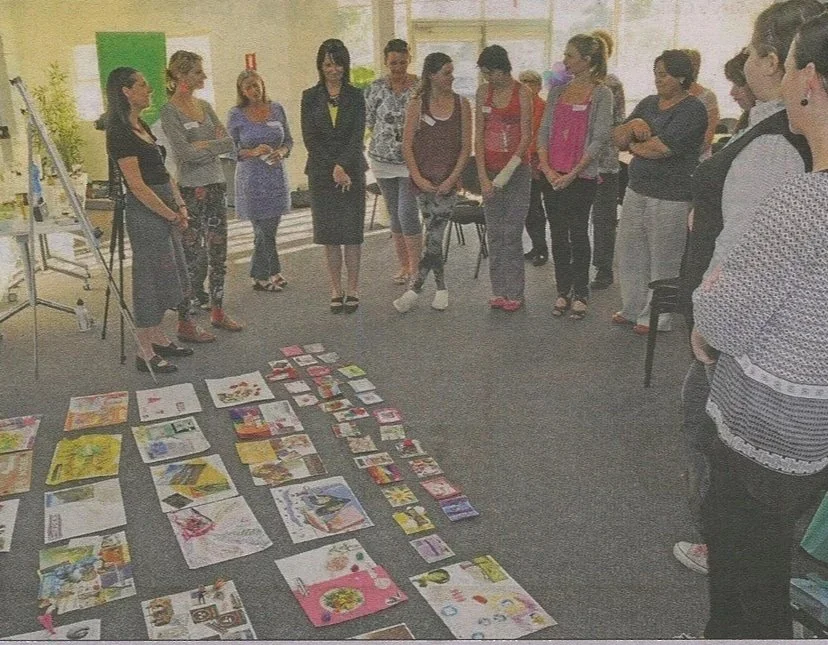
Select Presentations
“Beyond Four Walls: Therapeutic options for young people at risk”
Co-presented for Melbourne City Missions’ FRMP program
Council for Homeless Persons Conference
Ballarat November 2025
“Creative Arts Therapy in a Family Services Program - supporting women & children experiencing family violence”
Co-presented with Delwyn Hopkins representing Anglicare Victoria
16 Days of Activism: Healing & Recovery Forum Maryborough, December 2019
“My House, Your house: Creative Arts Therapy in a Family Services Program”
Co-presented with Delwyn Hopkins representing Anglicare Victoria
ANZACATA Symposium Brisbane, October 2019
“Experiential & Creative Processes in Nature Workshop”
Co-facilitated with Erica Gurner (Human Nature Connect) & Maureen Carey (Outdoors Inc.)
AAEE Next Steps Conference Melbourne, September 2012
*Accompanying journal article